Description
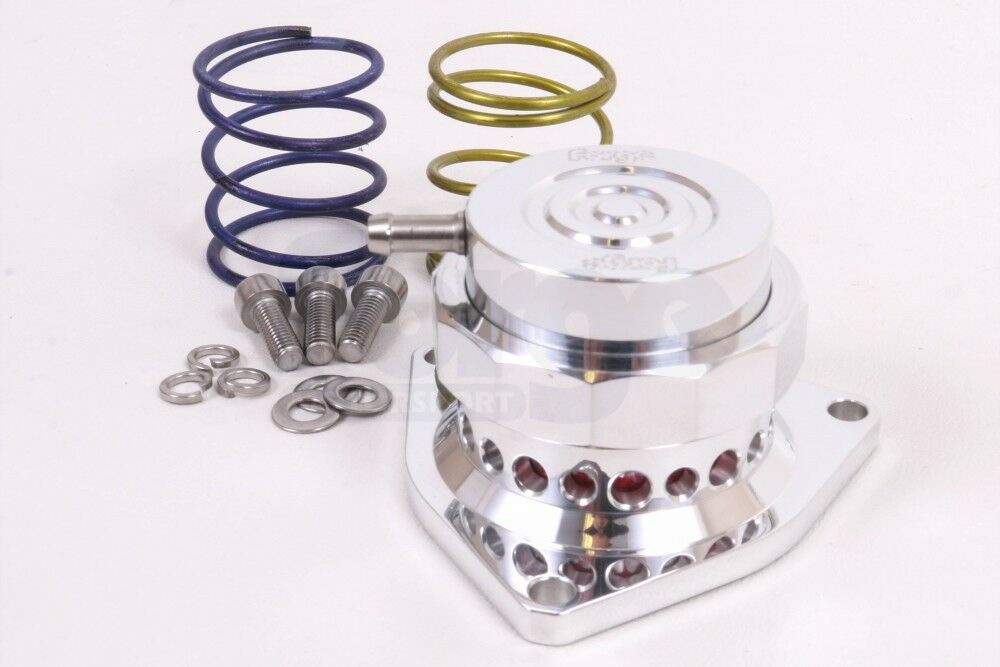
– billet aluminum construction
– Viton
silicone o-ring sealed piston-based internals – no diaphragm to fail
–
3 interchangable springs and included shims to adjust for varying boost
levels
– o-ring sealed cap with swivel vacuum nipple
– fully
rebuildable
The Forge direct replacement blow-off valve is
designed to be a more durable and performance oriented valve than the
OEM unit. The OEM valve is suitable for stock boost levels for a period
of time, however, once boost pressure is raised, and after prolonged
use, the stock valve will no longer be adequate. Raising the boost
output of the vehicle will have a number of effects on the OEM valve.
First and foremost, the additional boost pressure will quickly exceed
the capacity of the OEM spring to keep the valve closed under higher
boost levels. Since you cannot change the springs in the OEM valve, it
cannot be adjusted for higher boost levels. Secondly, the additional
heat generated by the increased boost will quickly deteriorate the OEM
rubber valve diaphragm, which will also lose strength with repeated
oscillations. The Forge valve uses full billet aluminum construction and
Viton silicone o-rings that will withstand the highest boost levels and
repeated abuse. It is also tunable for varying boost levels with the
included spring tuning kit. If there is ever a problem with the valve
such as a torn o-ring, replacements are available free of charge, and
the valve is fully rebuildable. Because the Genesis Coupe 2.0T does not
use a MAF (mass air flow) sensor, there is no reason that the residual
boost pressure at throttle lift cannot be vented to the atmosphere such
as with this valve. The engine management does not meter the air volume
entering the engine, so this residual pressure can be discharged without
any adverse affects on the performance or driveability of the vehicle.
Additionally, the valve being open at an idle or vacuum condition is a
normal occurance, and is not indicative of a leaking valve. If the
intake manifold is in vacuum, even while cruising at speed, the valve
may be open. The OEM valve operates in this same manner, however, it is
just not visible/audible because it is recirculating instead of vented
to the atmosphere. Using a stiffer spring to keep the valve closed at a
vacuum condition may result in too stiff of a spring tension to
effectively discharge pressure at a throttle lift condition.